
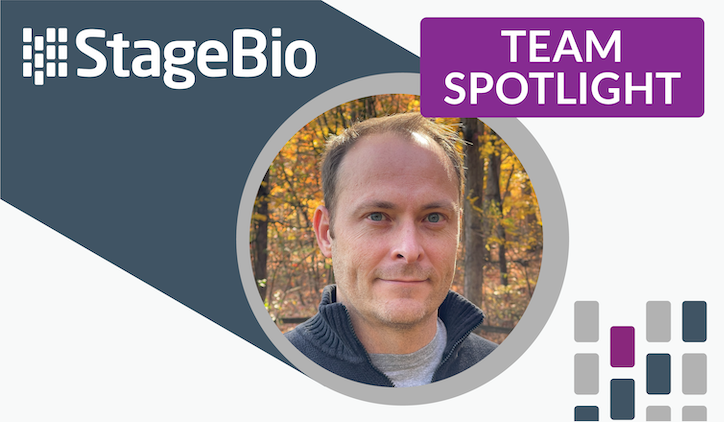


Meet Brian Tabb, StageBio's Lead Scientist of Investigative & Molecular Pathology! Brian brings hands-on expertise across research, clinical veterinary, and human laboratory settings to help drug developers design smarter staining strategies and get the most meaningful data from their preclinical tissue samples.
In this Employee Spotlight, we sit down with Brian Tabb to learn about his role overseeing the company's IHC and in-situ hybridization program. With a career that spans NCI-supported research histology, clinical veterinary, and human laboratory work, Brian brings a rare breadth of scientific perspective to every client engagement. At StageBio, he translates that experience into practical guidance, from marker selection and section scheme design to troubleshooting challenging tissue samples, helping clients build studies that are scientifically sound, efficiently executed, and aligned with their program goals from the start.
1. Can you introduce yourself, share your role at StageBio, and what initially drew you to join the team?
I started my career working in research histology, supporting the National Cancer Institute. From there, I moved into a clinical veterinary lab and then a clinical human laboratory setting. Each of those environments gave me a different lens on how tissues are processed, interpreted, and used to inform decisions, and that breadth has been invaluable in my current work.
After spending time in the clinical industry, I realized that supporting preclinical research was a better fit for me. The work feels more exploratory and collaborative. You're often helping a team figure out the best path forward rather than running a defined diagnostic workflow. That problem-solving element is what I find most rewarding, and it's a big part of what drew me to StageBio.
2. What does a typical day look like for you at StageBio - from your first client interaction to wrapping up internal collaboration?
No two days look exactly the same, which is something I genuinely appreciate. On any given day, I might be meeting with prospective clients to understand their programs, discussing scope, tissue types, and what they're hoping to learn from their data, while also checking in with repeat clients on new projects and staying in close contact with teams on studies already underway.
I work alongside the commercial group to help quote projects accurately, making sure the proposed scope reflects what the science actually requires, and I'm involved in setting up projects in the lab, coordinating ordering, and supporting protocol development as needed. There's also a fair amount of collaboration with our pathologists and imaging department, reviewing slides and working through findings together.
3. How do you see your role supporting both our internal scientific teams and our clients throughout the lifecycle of a program?
I oversee StageBio's Immunohistochemistry and In-Situ Hybridization program. A big part of that role is working closely with clients and pathologists to determine the most appropriate markers for a given study. This isn't always as straightforward as it sounds! Marker selection has real downstream implications for data quality and interpretability, so we take time upfront to understand the biology the client is trying to interrogate before making recommendations.
I also assist with trimming and section scheme design as needed, helping to ensure that the tissue architecture captured on the slide is positioned to answer the study's key questions. Throughout a program, the goal is to function as a true scientific partner, not just a service provider executing a request, but a collaborator who's invested in helping clients get the best possible data.
4. What types of challenges or questions do clients most often come to you with, and how do you help guide them toward the right StageBio solutions?
One of the more common situations we encounter is when a client comes to us after tissues have already been collected, sometimes under conditions that weren't optimized for downstream IHC analysis. Suboptimal fixation or storage can introduce real challenges, particularly for immunohistochemistry, where tissue quality has a direct impact on staining performance. Rather than simply flagging what won't work, we make it a priority to find what will.
In those situations, we work with the client to identify alternative approaches that can still yield meaningful, usable data, even if we're not able to complete every stain that was originally requested. It's about being honest with clients while staying solution-oriented, because the goal is always to help them move their program forward with the best information available.
5. Can you share an example of a memorable project where your team went beyond standard analysis to add real value for a client?
A recent example that stands out involved a client who had been advised by another company to pursue a complex section scheme. It would have required significant time and cost to execute, and when we reviewed it, it wasn't clear that the complexity was justified by the scientific return. We worked with the client to develop a simplified approach that still captured the quality information they needed, at a fraction of the original cost and in considerably less time. The client was relieved, and it's the kind of outcome that reinforces why we take the time to ask those early questions.
It really speaks to the approach we take with every project: we're not just processing samples, we're thinking about how to help clients run their programs efficiently. When budget is a limiting factor, we'll often find ways to structure a study that preserves scientific rigor without unnecessary expense.
6. How does your team leverage advanced tools and technologies to enhance evaluations, and what sets StageBio's capabilities apart?
We have multiple staining platforms, including Roche, Leica, and Biocare, which gives us meaningful flexibility when it comes to optimizing protocols for different tissue types and targets. Rather than being constrained to a single platform, we can select the instrumentation best suited to a given study, which matters when you're working across a wide range of species, tissues, and markers. Combined with our in-house imaging capabilities and close collaboration with our pathology team, that flexibility is part of what allows us to consistently deliver high-quality, interpretable results.
7. How does involving StageBio early in preclinical development improve outcomes and help de-risk client programs?
Getting StageBio involved at the protocol development stage is advantageous for everyone. Once we understand a client's end goals, we can help build a strategy that covers the full arc, from tissue collection through sectioning and staining, designed to meet their specific needs.
Early involvement means we can flag potential issues before they become problems: whether that's a fixation protocol that could limit downstream IHC options, a section scheme that might not capture the relevant tissue architecture, or a marker panel that may need refinement. Addressing those things at the planning stage is far less costly, in time, money, and sample, than troubleshooting them mid-study. It's one of the clearest ways we add value as a research partner.
8. What emerging technologies or methodologies in your field are transforming how therapeutic assets are evaluated, and how is StageBio adapting?
Spatialomics analysis is becoming an increasingly requested technique. It allows researchers to map gene expression or protein distribution within the spatial context of a tissue section, providing a layer of biological insight that traditional IHC alone can't capture. As that demand grows, we've recognized that clients need a clear path to access those capabilities.
While StageBio doesn't offer spatialomics directly, we've positioned ourselves by partnering with a company that specializes in this type of analysis, so clients can work through us to access those services without having to manage multiple vendor relationships independently. It's part of how we're thinking about staying ahead of where the science is going.
9. For biotech teams evaluating CRO partners, what three questions should they ask to ensure their partner adds true scientific value?
-
Do you have experience analyzing our target tissue(s)? Tissue-specific expertise matters more than it might seem. Processing and interpreting liver is different from brain, lung, or tumor microenvironments, and a partner with direct experience in your tissue of interest is better positioned to anticipate challenges and design an appropriate workflow.
- Do you have any suggestions about ways we can obtain clearer results? A CRO worth partnering with shouldn't just answer the question you ask. They should proactively bring ideas to the table. If your potential partner isn't offering scientific input during early conversations, that tells you something.
-
Would our project benefit from semiquantitative scoring or quantitative image analysis? This is a question that often gets overlooked until it's too late to design for it properly. Understanding the level of analytical rigor your study requires, and making sure your CRO is equipped to deliver it, can make a meaningful difference in how your data holds up during regulatory review or publication.
10. How do you like to spend your time outside the lab?
Outside of work, I'm an avid cornhole player. I compete in both summer and winter leagues and participate in tournaments when I can. It's a sport that takes more precision and consistency than it might look like from the outside, and the competitive community around it is genuinely a lot of fun to be part of!
Brian's career path, from NCI research histology through clinical veterinary and human labs to preclinical CRO science, gives him a scientific perspective that's genuinely difficult to replicate. His ability to meet clients where they are, whether they're designing a study from scratch or troubleshooting a challenging sample set, reflects the kind of expert, solution-first partnership that StageBio is built on. From marker selection and section scheme design to cost-effective study restructuring, Brian and the IHC team are equipped to help you build studies that are scientifically rigorous and efficiently executed. If you're planning your next preclinical program, there's clear value in getting that conversation started early.
Connect with our team today!

 513.204.4400


