
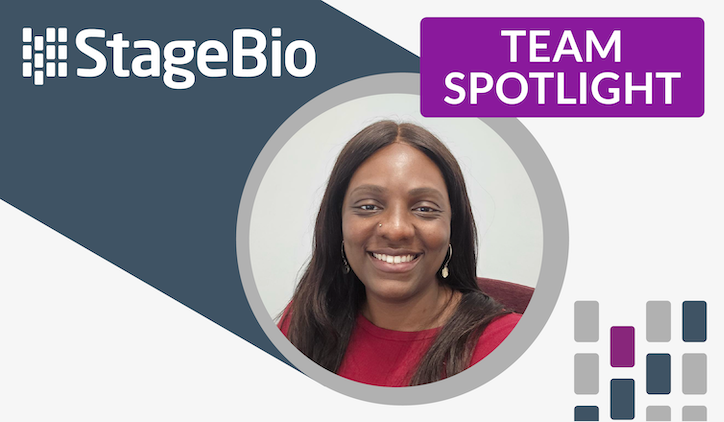


Meet Alero Nesiama, Operations Manager at StageBio.
In this Employee Spotlight, Alero shares what brought her back to the CRO world, how she supports the Materials Coordination and Biorepository & Archiving teams, and why careful material handling is at the heart of building client trust.
1. Can you introduce yourself, share your role at StageBio, and what initially drew you to join the team?
Hi! My name is Alero Nesiama. I am the Operations Manager here at StageBio. I spent about 6 years at a large CRO and I absolutely loved the work that was done. I had a short stint at a local hospital and missed this industry very much. When I came in for my interview, I got the sense that this organization had the family atmosphere that I was longing for. I was fortunate enough to get a call back and here I am.
2. What does a typical day look like for you at StageBio, from the moment you walk in to signing off on deliverables?
No day is "typical” here at StageBio, that's one of the things I enjoy most about my role. Over the past few years, our Frederick headquarters have evolved into our US-based hub that supports all our histopathology specialty areas under one roof. As we've grown and expanded our capabilities, a key focus of my role is helping optimize the use of space and resources to support greater operational efficiency. We continuously evaluate how our work environment can be organized to better support our teams, streamline workflows, and maximize productivity.
I spend a lot of time talking with team members to better understand what they do and what they need to be successful. The people doing the work every day often have the best insights, so I enjoy learning from them and finding ways to support their efforts.
I've also recently had the opportunity to work more closely with our Biorepository & Archiving team. Right now, I'm focused on learning their processes, understanding where we are today, and helping identify ways we can continue to improve. At the end of the day, it's all about creating efficient, organized operations that allow our teams to do their best work and continue providing great service to our clients.
3. What are your core responsibilities at StageBio, and how do you collaborate with clients throughout their programs?
I am working with the Materials Coordination team, the Biorepository & Archiving team, and general laboratory operations. I will be focused on supporting our clients by ensuring we get equipment, records, and study materials where they need to be by the time they need to be there.
4. What are the most common challenges clients bring to you, and how does StageBio's approach help solve them?
In my time so far at StageBio, I have seen that the most common challenge is material handling. Clients want to know where their material is and that we are handling it correctly. Though this seems like a simple ask, it is important for clients to trust us and know that their material is in good hands. StageBio is committed to quality and meeting the needs of the clients. We are deeply invested in meeting with clients one-on-one so that we can understand their needs and come to a solution together. We conduct very thorough investigations and make sure that we identify solutions when we meet with clients. From my experience, this proactive approach helps to reassure clients and build trust.
5. Can you share an example of a memorable project where your team went beyond standard analysis to add real value for a client?
There were slides that had to be shipped to a pathologist…NOW… while the FDA was here!! The Materials Coordination team needed to be available at a moment's notice for the inspection and at the same time meet an immediate deadline for a client. The team worked diligently to get the study out, even volunteering to drive it to UPS themselves. It was a great reminder that you can only control what you can control and to stay calm in high-pressure situations.
6. What's one thing drug developers often overlook in their programs that you wish they better understood?
Material disposition at the conclusion of the study, specifically for non-regulated studies. This is something that I have come across quite a bit throughout my career. The study material is forgotten about, leaving the CRO to have to track down the client and get direction from them. Having a buildup or backlog of material puts a strain on internal resources. If clients and drug developers understood this small detail, workflow would be a much smoother process. This is something we work with the client to address during the quoting process.
7. How does involving StageBio early in preclinical development improve outcomes and help de-risk client programs?
Early involvement allows us to build a strong rapport with the client. We get more of a chance to work with the client and understand what they are looking for and how we can support them. StageBio has a wide variety of services that can be tailored to the client's needs for the best outcome. Collaboration is one of the most important steps in creating the foundation of a working relationship.
8. What emerging technologies or methodologies in your field are transforming how therapeutic assets are evaluated, and how is StageBio adapting?
Emerging technologies such as AI-driven image analysis, high-throughput molecular profiling, and integrated digital pathology platforms are reshaping how therapeutic assets are evaluated, and StageBio is adapting by expanding its histopathology, imaging, and data-science capabilities to deliver regulatory-ready, data-rich insights.
9. For biotech teams evaluating CRO partners, what three questions should they ask to ensure their partner adds true scientific value?
What information is needed up front?
Thorough study preparation is essential to delivering an exceptional client experience. When clients provide complete study information upfront, our team can anticipate unique requirements, streamline planning, and ensure seamless execution from material receipt through final report delivery.
How do we protect intellectual property and ensure data integrity?
Protecting intellectual property and maintaining data integrity are essential. Discovery data often serves as the foundation for future partnerships, valuations, and regulatory submissions.
Are we compliant with global regulatory standards?
Regulatory readiness should be a priority at every stage of drug development. Research data produced today often becomes critical for supporting future IND-enabling studies. Leading full-service drug discovery CROs incorporate regulatory standards into daily operations, ensuring compliance is built in from the start rather than added as an afterthought.
10. How do you like to spend your time outside the lab?
I am an avid movie watcher. I love '80s movies (The Karate Kid and Annie are my absolute favorites). I also love to cook. Food always tastes better when it is homemade!
For Alero, operations is about more than logistics. It's about making sure every slide, record, and sample is accounted for, so clients never have to wonder where their material is. Her years of CRO experience have given her a practical eye for the details that keep studies running smoothly, including the ones that are easy to forget, like planning for material disposition before a study ever wraps. And when the pressure is on, she and her team know how to stay calm and get it done. It's that mix of steady hands and genuine care that makes the family atmosphere Alero was looking for when she joined StageBio show up for clients, too.
Have questions about how StageBio manages, tracks, and archives your study materials? Alero and the team would be glad to talk. Connect with our team today!

 513.204.4400


